

 This tutorial covers the PengAOL software installation and configuration
necessary for one to connect to AOL using Linux. (uses P3 protocol)
It is assumed that you have a working telephone modem.
(There is also an option for using DSL.)
This tutorial covers the PengAOL software installation and configuration
necessary for one to connect to AOL using Linux. (uses P3 protocol)
It is assumed that you have a working telephone modem.
(There is also an option for using DSL.)
If you get one of those free CD's from AOL, it is not enough to get started. I had to first use the AOL software on a MS/Windows PC with the given "Registration number" and password to sign-on and obtain an account. The registration process will allow you to choose a login "handle" and login password. It is this login and password which will be used to login using the PengAOL Linux dialer. Once you have performed the registration process and obtained the necessary information you will no longer need the MS/Windows PC. Configuration of both the command line and GUI versions of the PengAOL dialer are covered in this tutorial.
Steps to install and use PengAOL dialer:
- Download: Download PengAOL software from SourceForge.
This tutorial covers PengAOL version 1.0. I also tried 0.96 (RPM version) with less than satesfactory results. I am using Red Hat Linux 7.2 for this tutorial but due to the fact that one can compile the source code, I feel that it is probably Linux version and release independant. Download at least version 1.0beta1. Two downloads are available:- peng1.0a01.tar.gz - Source and precompiled executables.
- QTkylix.tar.gz - Kylinx libraries used for GUI version. Covered at end of tutorial.
- Unpack and install:
[root prompt]# tar xzf peng1.0a01.tar.gz
[root prompt]# cd peng
[root prompt]# ./recompile      - Optional and recommended. Compile from source and install.
                                  Uses local language environment variable for configuration.
OR
[root prompt]# ./Install        - Use precompiled binaries
Note the install scripts will configure the following:
While I find this acceptable for my own personal workstation, it may not be acceptable for a public system. It's your call. I personally use an external modem on COM2 (/dev/ttyS1). Many internal modems use other serial ports may require the appropriate configuration.
Software installed:
/usr/bin/pengaol
Configuration and data files installed:
/usr/bin/peng
/usr/bin/pengsetup - GUI configuratiojn program. Did not work for me. Just locks up and waits. /usr/bin/PengGui - GUI program. See configuration below. /usr/bin/wavplay/etc/Pengaol/PengAol.conf - Edit this file. See below. /etc/Pengaol/Dns - Same purpose as /etc/resolv.conf. List of name servers /etc/Pengaol/PengMessages.txt /usr/share/sound/goodbye.wav /usr/share/sound/waw.wav /usr/share/sound/welcome.wav - Configuration:
- Edit configuration file: /etc/Pengaol/PengAol.conf
Change the following:
[CModemDriver]
...
PhoneNbr=0860880310       - Change to actual dial-up number for telephone modem access.
AutoDetected=/dev/ttyS0   - On my system I use an external modem on /dev/ttyS1
...
Default phone number in code and config file: 0860880310 (Somewhere in France - Don't use it!!!) In america I use the local phone number without the area code. There did not seem to be any command or GUI interface to manage the access number. There is just you, the file and a text editor.
- Shut down other internet connections:
I turned off my DSL connection. (It's not like I really use AOL): ifdown eth0[Potential Pitfall]: If you leave any other internet connections active, PengAOL will test, find and use a connection driver which may not be the one you counted on. When dialing in to AOL by modem, I kill the ethernet connection. (Not a problem with regular PPP access to generic ISP's or Compuserver.)
- Add user to the connection list: pengaol -AddUser [login] [Password]
Add your AOL login and password to the list of users. This is stored in the
File: $HOME/.PengUser
The password is stored encrypted.
- Edit configuration file: /etc/Pengaol/PengAol.conf
- Test auto driver detection: pengaol -ListDriver
Load language : en Driver Name : CPppDriver Author : Birdy57 Message included : Vers 0.55 Linux Guid : 3812 The pilot works on this configuration :Yes Driver Name : CTunTapDriver Author : birdy57 Message included : Vers 0.5 Linux Guid : 4212 The pilot works on this configuration :No Driver Name : CCableDriver Author : birdy57 & surfufu Message included : Vers 0.5 Multi Guid : 8301 The pilot works on this configuration :No Driver Name : CModemDriver Author : Birdy57 Message included : Vers 0.5 Linux Guid : 1711 The pilot works on this configuration :Yes - Dial AOL and use internet connection:
pengaol -User [login] [Password]
  OR
pengaol -AddUser [login] [Password]        - Do this once to add user to $HOME/.PengUser
pengaol -Connect [login]
Other command line examples:
pengaol -DelUser [login]
pengaol -ListUser
Other command line options require the setting of compilation flags to turn them on. (i.e. -Debug, -Log,...) - Terminate the session: killall pengaol or CNTL-c
[Potential Pitfall]: If it doesn't connect try a different access number.
In addition to the pengaol configuration set-up above, perform the following additional steps:
- Download and install:
[root prompt]# tar xzf QTkylix.tar.gz  - Required for GUI interface users
[root prompt]# cd QT/
[root prompt]# ./install
This will create the directory /opt/qtkylix and copy the Kylix libraries to this directory. - Run GUI dialer:
Script to start GUI version of AOL dialer found in: peng/peng/pengui
#!/bin/sh export LD_LIBRARY_PATH=/opt/qtkylix ls -l /dev/modem > /tmp/Modem.txt PengGui- Select "Connect" button:
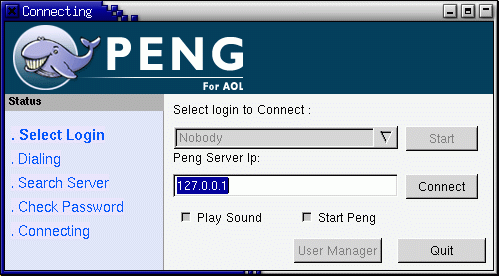
- New dialog box appears. Select "OK":
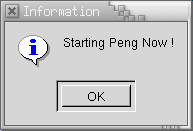
- Select appropriate login from pull-down menu and select "Start" button:
(or select "User Manager" button to add and configure user - once)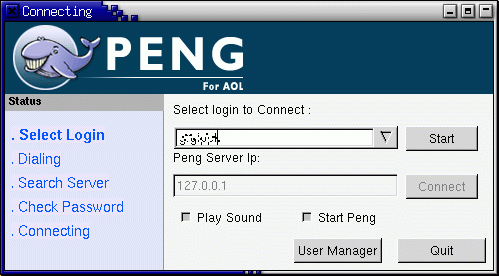
- User Manager: add/delete/edit a login/password:
(Add and configure user - once)
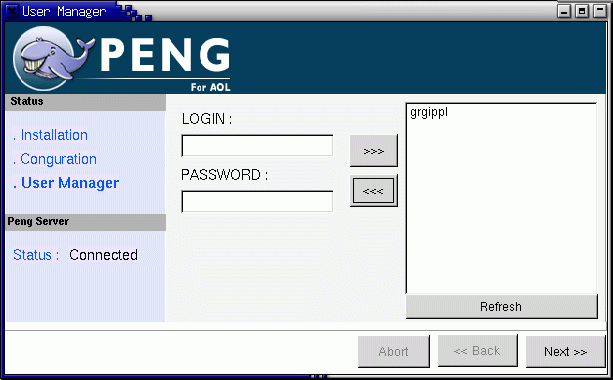
- Select "Start" button. System will dial and connect:
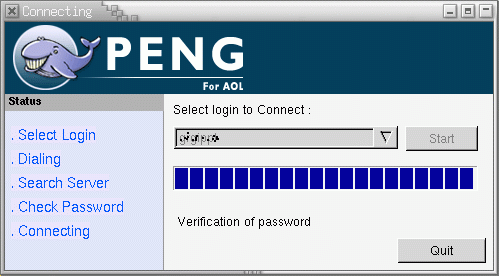
- GUI will show stats:
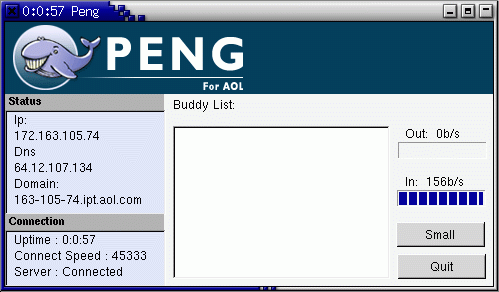
- The "Quit" button will disconnect you from AOL.
- Select "Connect" button:
Dial up modem access numbers may be obtained by first using the nationwide
(U.S., Puerto Rico, and the US Virgin Islands) modem dial-up number:
1-(800)716-0023
(they charge 10 cents a minute or $6.00 per hour)
This will connect you to the internet.
Access numbers are no longer posted on the AOL website. They can be obtained by installing the AOL dialer on a supported OS or with Wine and using the dailer software to look up an access number.
Call and get a number (beware they make you wait for an operator): (800)827-6364
Checking your email can be done in two ways:
- Go to Aol.com and use the web interface.
- Download Netscape 6.1+ and use it to access AOL email via the
AOL IMAP interface.
When adding a new email account to the Netscape configuration it will
allow one to configure the account for POP, IMAP, AOL or a Newsgroup.
Choose AOL.
It works!! Even though Mozilla is almost exactly the same as Netscape 6+
on Linux, only Netscape supports AOL mail.
- Select from the browser toolbar "Tasks" + "Mail".
- From the new Mail window select "Edit" + "Mail/News Account Settings...".
- Selecting the "New Account" button will bring up a wizard to create the new AOL mail account.
- To use the account select the AOL Mail account "Mail Folder". You will now be in the AOL mail environment to read, archive and delete mail. This will require the use of your AOL screen name and password.
- AOL Servers:
- IMAP: imap.aol.com
- SMTP (outbound): smtp.aol.com
(Use AOL login/password)
- PengAOL
- Sourceforge.net: PengAOL Project Home Page
- SourceForge.net: PengAOL - Software download site
- AOL.com home page - allows web access to AOL mail.
- AOL phone number to cancel service: (800)827-6364
- AOL keyword: BILLING
- gAIM - AOL Instant messager client for Linux. I use it, it works great!! AOL internet connection not necessary.
- Connecting to "Compuserve Classic" - YoLinux TUTORIAL
- Connecting to your generic ISP using PPP - YoLinux TUTORIAL

